The phrase “let alone” is one of the most commonly used expressions in English conversations, writing, social media, and daily communication. People often hear it in movies, songs, interviews, or casual discussions but may still feel confused about its exact meaning and correct usage.
Understanding the let alone meaning can greatly improve your English fluency because this phrase helps compare situations and emphasize impossibility, difficulty, or contrast in a very natural way.
Native English speakers frequently use “let alone” to show that if one thing is impossible or unlikely, another thing is even more impossible or unlikely. It creates emphasis and helps strengthen a statement without using too many extra words. Because of this, the phrase appears in both formal and informal English.
For example, someone may say, “I can’t afford a bicycle, let alone a car.” This means the person cannot afford a bicycle, and since a car is more expensive, affording a car is even less possible.
Learning expressions like this helps you sound more natural and confident while speaking English. In this detailed guide, you will learn the complete meaning of “let alone,” its grammar rules, sentence structure, origins, examples, common mistakes, and differences from similar phrases. By the end, you will fully understand how and when to use this powerful English expression correctly.
What Does “Let Alone” Mean?
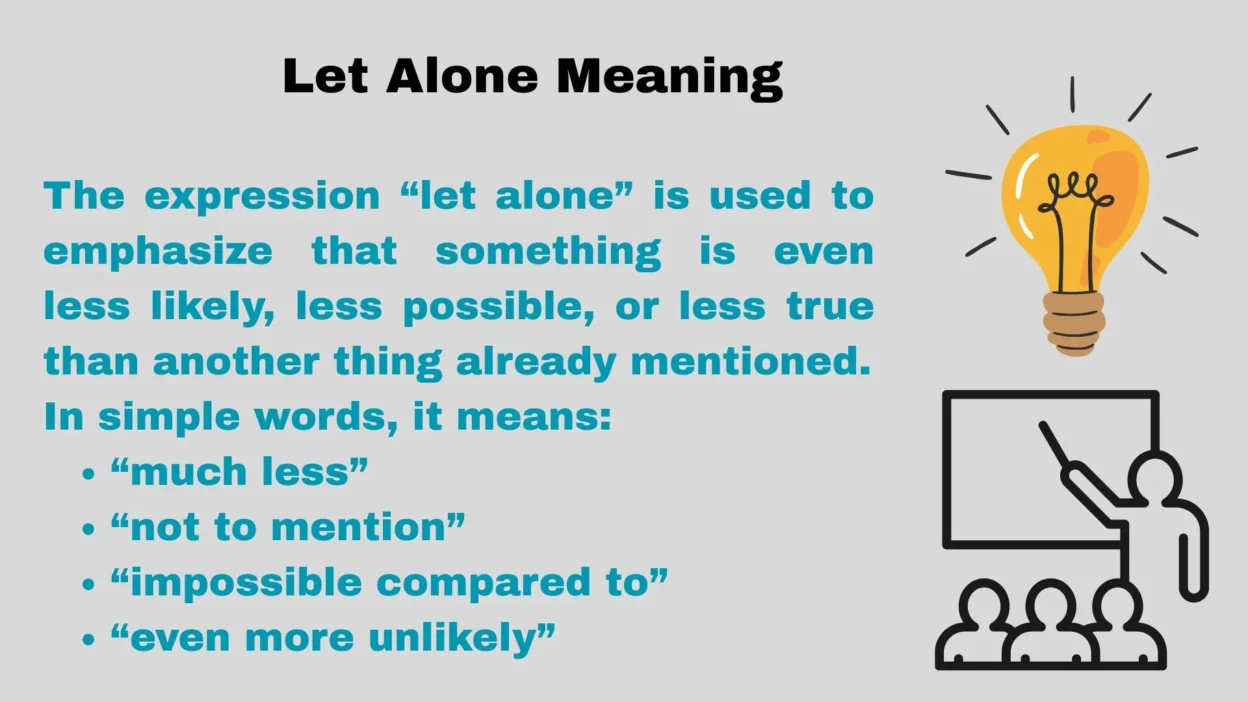
The expression “let alone” is used to emphasize that something is even less likely, less possible, or less true than another thing already mentioned.
In simple words, it means:
- “much less”
- “not to mention”
- “impossible compared to”
- “even more unlikely”
The phrase is usually used when comparing two situations where the second situation is more difficult, extreme, expensive, complicated, or unlikely than the first one.
Basic Structure
The usual structure is:
Subject + first statement + let alone + second statement
Example:
- “She can barely cook noodles, let alone a full dinner.”
This means if she struggles with cooking noodles, preparing a complete dinner is far beyond her ability.
Why People Use “Let Alone”
People use “let alone” because it makes sentences stronger and more expressive. Instead of explaining everything in detail, the phrase quickly shows comparison and emphasis.
Main Reasons for Using It
- To emphasize impossibility
- To compare difficulty levels
- To sound natural in English conversation
- To avoid repeating unnecessary details
- To create stronger emotional impact
Example:
- “He doesn’t have time to rest, let alone take a vacation.”
This sentence immediately shows that taking a vacation is completely unrealistic because even resting is difficult.
Examples of “Let Alone” in Everyday Sentences
Understanding examples is the best way to master the expression.
Examples About Money
- “I can’t pay my rent, let alone buy a new house.”
- “She barely saved ten dollars, let alone thousands.”
Examples About Time
- “He doesn’t have time to exercise, let alone join a gym.”
- “I can’t finish this project today, let alone this week.”
Examples About Ability
- “She can hardly walk, let alone run a marathon.”
- “He struggles with basic math, let alone advanced physics.”
Examples About Emotions
- “I can’t even think clearly, let alone make an important decision.”
- “They weren’t ready for marriage, let alone raising children.”
Grammar Rules for “Let Alone”
The phrase “let alone” follows certain grammar patterns in English.
Using Nouns After “Let Alone”
Example:
- “He can’t afford lunch, let alone dinner.”
Both “lunch” and “dinner” are nouns.
Using Verbs After “Let Alone”
Example:
- “She can’t swim, let alone dive.”
Both are verbs.
Using Adjectives After “Let Alone”
Example:
- “The room wasn’t clean, let alone organized.”
Using Entire Clauses
Example:
- “I don’t understand the lesson, let alone how to solve the homework.”
The phrase works flexibly in many sentence forms.
Origin of the Phrase “Let Alone”
The phrase has existed in English for centuries. Historically, “let” once meant “leave” or “allow.” Over time, “let alone” developed into an idiomatic expression meaning “not to mention” or “much less.”
Writers and speakers began using it to strengthen comparisons and make arguments clearer. Today, it is considered a standard English idiom and appears in books, newspapers, academic writing, and casual speech.
Difference Between “Let Alone” and “Not to Mention”
Many learners confuse these two expressions because they look similar. However, they are slightly different in tone and usage.
“Let Alone”
Used to emphasize that the second thing is less possible.
Example:
- “I can’t cook pasta, let alone sushi.”
“Not to Mention”
Used to add extra information.
Example:
- “The hotel was expensive, not to mention uncomfortable.”
“Let alone” focuses more on impossibility or difficulty, while “not to mention” simply adds another point.
Common Mistakes When Using “Let Alone”
English learners sometimes misuse this phrase.
Incorrect Comparison Order
Wrong:
- “I can’t buy a mansion, let alone a sandwich.”
Correct:
- “I can’t buy a sandwich, let alone a mansion.”
The second item should usually be more difficult, expensive, or extreme.
Using Unrelated Ideas
Wrong:
- “She likes music, let alone pizza.”
These ideas are unrelated.
Correct:
- “She doesn’t enjoy singing, let alone performing on stage.”
The comparison must logically connect.
“Let Alone” in Formal and Informal English
One great thing about this phrase is that it works almost everywhere.
Informal Use
Friends often use it casually.
Example:
- “I can’t wake up before eight, let alone five.”
Formal Use
It also appears in academic or professional writing.
Example:
- “The company could not meet local demand, let alone international expectations.”
Because it sounds natural and intelligent, many writers prefer using it.
Synonyms of “Let Alone”
Several phrases have similar meanings.
Common Alternatives
- Much less
- Not to mention
- Never mind
- Still less
- Far less
Example:
- “He can’t read English, much less write essays.”
These alternatives may slightly change tone or formality.
How to Practice Using “Let Alone”
Improving your English requires practice.
Useful Practice Methods
Read English Conversations
Watch how native speakers use the phrase naturally.
Write Your Own Examples
Create sentences related to your daily life.
Example:
- “I can’t stay awake past midnight, let alone study.”
Listen to Movies and Podcasts
You will hear the expression frequently in natural speech.
Practice Speaking
Try using it in conversation with friends or language partners.
Why “Let Alone” Is Important in English
The phrase is important because it helps speakers communicate stronger meaning using fewer words. Instead of giving long explanations, “let alone” quickly shows comparison, impossibility, or exaggeration.
It also makes speech sound more fluent and natural. Advanced English speakers often use expressions like this automatically, which is why learning it can improve your communication skills significantly.
Whether you are preparing for English exams, improving business communication, writing articles, or speaking casually, understanding the let alone meaning can make your English clearer and more expressive.
Conclusion
The expression “let alone” is a powerful and practical English phrase used to emphasize that one situation is even less likely or more difficult than another. It commonly means “much less” or “not to mention” and is used in everyday conversations, formal writing, and professional communication.
By learning the correct grammar, sentence structure, and comparison logic behind the phrase, you can use it naturally and confidently. Remember that the second idea after “let alone” should usually be more extreme, difficult, expensive, or impossible than the first idea.
With regular reading, listening, writing, and speaking practice, this expression will soon become a natural part of your English vocabulary. Mastering phrases like “let alone” is one of the best ways to sound more fluent, expressive, and confident in real-world communication.

I’m Silas Everhart, a storyteller who loves weaving tales that linger in the mind.
Through lushystories.com, I share my journeys into passion, mystery, and imagination.
Every story I write is a piece of my soul, hoping to connect with readers worldwide.