
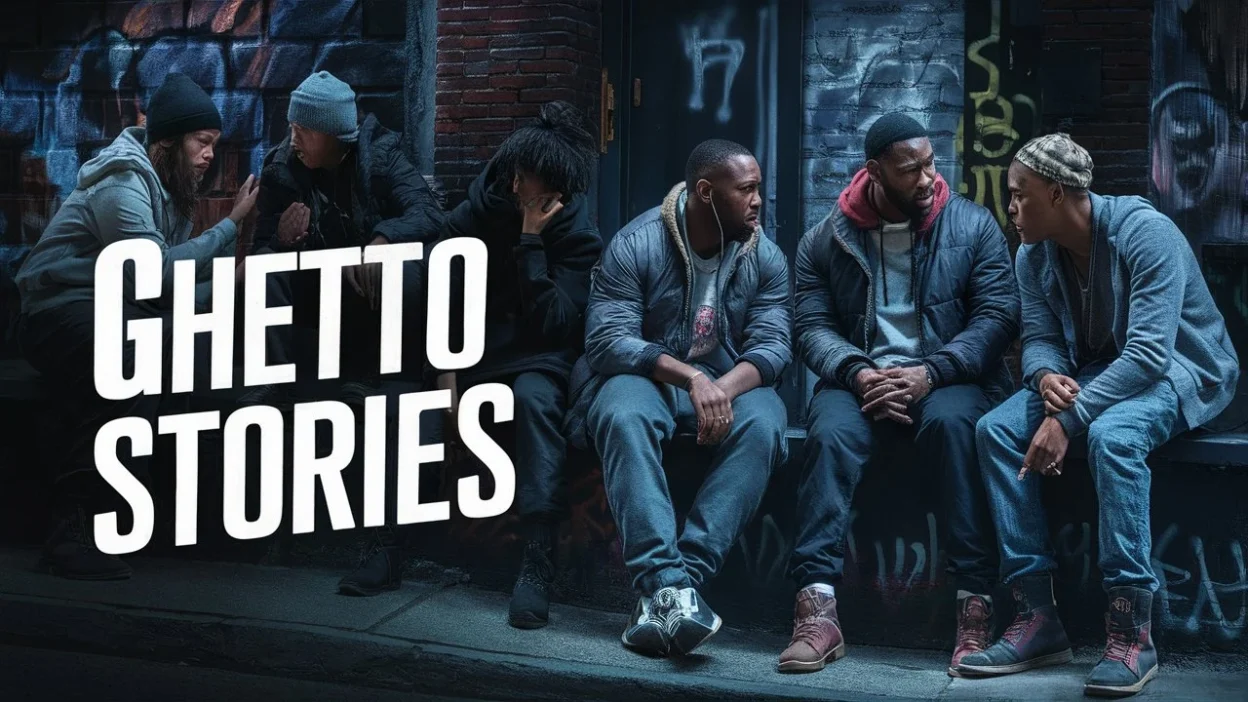
Ghetto stories have become some of the top, best, and most gripping reads for adult audiences who crave realism, grit, and emotional depth.
If someone searches for hot urban tales, raw neighborhood drama, or the intensity found in the best Shirley Jackson short stories, this collection offers the same edge but with a modern, urban twist.
Written for adults who enjoy bold themes, character-driven narratives, and street-level tension, these trending ghetto stories deliver authenticity, heart, and life lessons wrapped in dramatic storytelling.
Story 1 – The Block that Never Slept
Tasha lived on a block that never slept—a place where arguments cracked louder than fireworks and secrets traveled faster than whispers. Every night, she’d sit on the broken porch steps, staring at the flickering streetlight like it held an answer she hadn’t learned yet. The neighborhood was rough, but it was the only world she knew.
Every morning brought new drama: sirens at dawn, arguments by noon, kids dodging trouble like it was a sport. Tasha worked double shifts at the corner store, always promising herself she’d leave someday. But leaving the ghetto wasn’t as simple as buying a bus ticket; it meant escaping expectations, friendships, loyalties, and memories stitched into every street crack.
When her younger brother, Malik, started hanging with a dangerous crew, Tasha stepped in fast. She had seen too many kids fade into the block’s darkness, swallowed by choices they thought they controlled. Malik didn’t listen—until one night everything changed.
A fight broke out behind the store, loud enough to shake her nerves. She rushed out and saw Malik pinned against a wall by two older boys, his face pale with fear. Without thinking, she yelled, grabbed what she could, and waded into the chaos like a storm.
Her courage startled the attackers long enough for Malik to break free. They ran, breathless, not stopping until they reached home. That was the night Malik realized the streets weren’t his friends—and the night Tasha understood her role wasn’t just to survive but to guide.
Months passed. Malik returned to school, got a job, and distanced himself from trouble. Tasha felt the block shift around her—not quieter, but somehow less heavy. She still dreamed of leaving, but now she dreamed of leaving with Malik, not from him.
One evening, watching the familiar streetlight flicker again, she finally felt hope. The block still never slept, but for the first time, she didn’t feel trapped by its wakefulness.
Moral: Even in the hardest places, courage can rewrite someone’s future.
Story 2 – When the Music Stopped
DJ Rico was known on every street corner, every cracked sidewalk, and every block party that lit up the neighborhood. His mixes could turn fights into dance circles and silence into celebration. Music was his escape from the noise of the ghetto, a place where hope usually came in short supply.
Every Friday night, Rico set up his old speakers in the courtyard of the Towers. Kids danced, adults argued less, and for a few hours, the neighborhood felt alive. Music made everyone forget the bills, the struggles, and the long week behind them.
But one night, just as he plugged in his mixer, the power cut out. The courtyard went dark. People groaned, cursed, and returned to their own frustrations. Rico tapped the speakers—nothing. Someone shouted that the building’s wiring was finally done for. Another yelled that it was a sign the block was falling apart. The silence felt heavy and unfamiliar.
Rico didn’t accept it.
He ran upstairs to his grandmother’s old apartment, rummaging through decades of stored junk. Finally, he found what he needed: a dusty, old battery-powered speaker and a scratched-up MP3 player he’d used as a kid. It wasn’t much, but it worked.
Back outside, he held the tiny speaker high. People laughed at first—it looked ridiculous compared to his usual setup. But then he pressed play. The courtyard vibrated with a familiar beat, soft but steady. Slowly, conversations paused. Feet tapped. Smiles appeared.
Kids circled up and danced again. A couple who had barely spoken in months joined hands. The small speaker wasn’t loud, but the energy grew louder than anything Rico had ever mixed.
A neighbor approached him, tears in her eyes, and said, “Tonight could’ve reminded us of everything broken here. Instead, you reminded us of everything still alive.”
Rico realized then that the music wasn’t powerful because of the volume—it was powerful because of the people it brought together.
By the end of the night, laughter echoed through the courtyard. Someone even fixed the fuse box, and the lights flickered back on. Rico switched back to his full setup, but he kept the little speaker nearby as a reminder.
Sometimes the block stopped the music. But Rico learned the music didn’t have to stop.
Moral: Hope doesn’t need to be loud to change a neighborhood.
Story 3 – The Promise Under the Streetlight
Keisha and Darnell grew up on the same block, under the same flickering streetlight that had witnessed every fight, dream, and late-night confession. They were inseparable—two kids trying to stay clean in a place that constantly tried to dirty their futures.
Darnell’s older cousins ran with a crew that everyone feared. Keisha’s mother warned her often: “Some darkness ain’t meant to be understood—just avoided.” Still, Darnell swore he’d never get involved. He wanted better. He wanted out.
One summer night, Keisha found him pacing under the streetlight, shoulders tense, fists clenched. She knew something was wrong. He confessed that his cousins wanted him to help with a job—something dangerous, something foolish something he didn’t want any part of.
“They say I’m family. That I owe them,” he muttered.
Keisha stepped closer. “You don’t owe them your future.”
But pressure weighed heavy in the ghetto. Loyalty could be a trap disguised as love.
The next evening, Darnell disappeared. Keisha searched everywhere—the park, the corner store, the alleys near the basketball court. Hours later, she found him near the railroad tracks, shaken but unharmed. He’d refused to join the crew and walked away when they threatened him.
“They said I’m dead to them,” he whispered, terrified.
Keisha reminded him of the dream they once promised each other under the streetlight: escape, education, and a life where fear didn’t lead their decisions.
Darnell nodded. That night, he packed a bag and stayed with an aunt across town, far from the crew’s reach. Keisha visited him every weekend, cheering his progress. He enrolled in night school, got a job repairing bikes, and eventually cut ties with the block entirely.
Years later, Darnell returned—not to stay, but to bring Keisha with him. She had kept their promise alive, and he refused to leave her behind.
Under the same streetlight, now finally repaired and steady, they walked away from the shadows for good.
Moral: Real loyalty is choosing the path that protects your future, not the one that destroys it.
Story 4 – The Corner Store Queen
Miss Gloria owned the corner store long before most people on the block were even born. She wasn’t rich, but she carried herself like royalty. Kids called her the “Corner Store Queen,” partly as a joke and partly because she ruled her shop with fairness, attitude, and the kind of care only a community mother could give.
Her store sat in the heart of the ghetto, surrounded by cracked sidewalks and chipped murals. Every morning, she swept the steps while telling teens to keep their heads straight and stay in school. Every afternoon, she fed hungry kids out of her own pocket. Every evening, she reminded troublemakers that she’d seen better men than them fall because they thought they couldn’t.
But times were changing. A new group had moved into the neighborhood—loud, reckless, and convinced they owned the block. One night, they stormed into the store, demanding free snacks and threatening to “teach her a lesson” if she refused.
Miss Gloria didn’t flinch.
“You don’t scare me,” she said calmly. “Boys with louder mouths than yours used to sweep my floor for extra cash.”
They laughed and knocked over shelves. She stood like a statue, untouched by their chaos.
What the boys didn’t realize was that the entire neighborhood had eyes everywhere. Within minutes, a crowd gathered outside. Parents, teens, elders—everyone who respected Miss Gloria showed up. A few large men blocked the doorway, arms crossed, unmoving.
The boys froze.
One of the elders stepped forward. “She’s been feeding our kids, protecting our streets, and patching our wounds for decades. Don’t you dare disrespect her.”
The boys backed away slowly, realizing they weren’t just messing with a store owner—they were messing with the backbone of the block.
Miss Gloria didn’t say a word. She simply picked up her broom and started cleaning again. The neighborhood helped her stack shelves, straighten displays, and sweep the damage away.
When the last box was placed back, she finally spoke: “A block survives when a block fights for each other.”
From that night on, everyone watched over her store. She remained the Corner Store Queen—not because of her shop, but because of her heart.
Moral: A community’s true strength is revealed by the people it protects.
Story 5 – Lost Shoes at Sunrise
Jamal had exactly two prized possessions: his late father’s gold chain and a pair of spotless white sneakers he’d saved for months to buy. In a neighborhood where money stretched thin and life stretched thinner, those shoes made him feel sharp, confident, like he finally belonged somewhere beyond the ghetto’s limits.
Every morning, he walked to school carefully, avoiding puddles, dirt patches, and the dog that everyone swore was half-wolf. His friends teased him—“Bro, you treat those shoes better than your homework”—but they knew why they mattered.
One evening, a small group of older boys cornered him near the parking lot behind the rec center. They wanted the chain. When he refused, they grabbed the sneakers too. They shoved him, took everything, and vanished into the darkness.
Jamal sat alone for a long time, socks damp, heart heavier than the night air. He didn’t tell his mom—she already carried too many burdens. He didn’t tell his friends—he felt ashamed.
The next morning, he walked to school early, barefoot, hoping no one would see him. But Miss Raina, the janitor, spotted him first. She noticed the cuts on his feet and asked no questions—just took him inside, washed his wounds, and found an old pair of sneakers from the lost-and-found bin.
“They’re not new,” she said, “but neither is strength.”
Jamal wore them quietly.
Weeks passed, but the hurt stayed. Then one sunrise, as he walked toward school, he saw his stolen white sneakers hanging from a telephone wire above the block. A cruel joke. A reminder of what he lost.
But this time, he didn’t cry.
Instead, he met up with his friends and told the truth. To his surprise, they didn’t laugh—they rallied. They lifted him up, walked with him to school, cracked jokes to make him smile, and promised they had his back.
For the first time, Jamal realized he hadn’t lost everything. The shoes were gone, but he’d gained something harder to steal: a circle that stood with him.
When he reached the school entrance, he looked up one last time at the shoes swinging softly in the breeze—and let them go.
Moral: What’s taken from you can be replaced, but real support cannot.
Story 6 – The Last Bench on Maple Street
On Maple Street, there was an old wooden bench—splintered, uneven, and worn by the weight of a thousand conversations. Everyone in the neighborhood had sat on it at least once. Some cried there, some laughed, some healed. It was the unofficial heartbeat of the block.
Mr. Douglass, a retired bus driver, sat on that bench every afternoon with his newspaper and his slow, calm smile. Kids thought he was ancient. Adults thought he was wise. Teens thought he was a free therapist.
But the bench was falling apart.
One morning, the city marked it with bright orange paint: “REMOVAL SCHEDULED.”
The neighborhood panicked. That bench held more stories than any official landmark. It was where neighbors reconciled, where teens confessed fears they couldn’t share at home, where lonely elders found someone to talk to.
Mr. Douglass stared at the sign for a long time. Then he closed his newspaper and stood with surprising determination.
“We’re fixing it,” he announced.
No one believed him at first. But within hours, kids brought hammers, teens brought nails, and adults brought paint cans. Even the grumpiest neighbor showed up with sandpaper.
The whole block gathered around that bench like it was a family member needing surgery.
They patched the cracks, reinforced the legs, smoothed the splinters, and painted it a deep warm brown. By evening, it looked stronger than it had in decades.
The next morning, when the city workers arrived, they stopped in their tracks.
“This bench wasn’t safe,” one said.
“It is now,” Mr. Douglass replied.
The workers tested it—pressed on it, shook it, examined every joint. Finally, they nodded. The bench was saved.
Neighbors cheered, clapped, and hugged. For the first time in years, Maple Street felt united again.
That night, Mr. Douglass sat on the restored bench, smiling wider than ever. Kids sat beside him, adults stood nearby, and the sunset seemed warmer than usual.
Because saving the bench wasn’t just about wood.
It was about saving the heart of a community that still knew how to stand together.
Moral: A neighborhood becomes strong when everyone cares enough to protect what matters.
Story 7 – The Graffiti That Saved the Block
Nina had always been quiet, the kind of girl who blended into the peeling paint of her apartment building. But she had a secret talent: she was the best graffiti artist in the whole neighborhood. Her murals carried emotion—anger, hope, love, sorrow—everything the block felt but rarely spoke aloud. In a world shaped by ghetto stories, hers came through color instead of words.
One morning, the city announced plans to demolish the community center. Kids played there, elders met there, teens found guidance there. Losing it felt like losing the last good thing left. But no one knew how to fight something that seemed so final.
That night, Nina grabbed her worn spray cans and climbed onto the center’s brick wall. Under the buzz of the streetlights, she painted a mural unlike anything she’d ever attempted. A blend of real faces from the neighborhood, glowing colors, raised fists, open hands, and a massive heart at the center. It was raw. Beautiful. Honest. More powerful than any speech.
By sunrise, the entire block surrounded the wall, silent in awe. Even the hardest men—ones who rarely blinked at anything—stood still.
Someone took photos and posted them online. The mural spread fast, gaining attention far beyond the neighborhood. Soon journalists arrived, calling it one of the most powerful pieces of modern urban art, comparing its emotional depth to the impact found in the best Shirley Jackson short stories.
The city couldn’t ignore the sudden spotlight.
Meetings were scheduled. Protests organized. Support poured in. Within weeks, the demolition was paused, then cancelled entirely. The community center was saved.
Nina never sought credit. But the neighborhood knew. Kids brought her paintbrushes. Elders called her “our silent warrior.” Teens asked her to teach them. For the first time, she didn’t blend into the background—she became the heartbeat of the block.
Her mural still stands today, bright and alive, reminding everyone that sometimes the quietest person carries the loudest power.
Moral: Even the softest voice can spark the biggest change when truth is expressed boldly.
Story 8 – The Wallet on Pine Avenue
Trey lived on Pine Avenue, a street known more for trouble than kindness. He had learned early that people in the hood usually kept to themselves. But one morning, while walking to the bus stop, he found a thick leather wallet lying near the curb. Inside was a stack of cash—enough to cover his rent for two months—and an ID belonging to Mr. Kline, the old man who lived three buildings down.
Trey hesitated. He wasn’t a thief, but temptation whispered. He had bills due, cupboards nearly empty, and shoes worn thin. Taking the cash would be easy—no witnesses, no questions. A typical moment in many ghetto stories where survival clashed with morality.
But something didn’t sit right.
Mr. Kline was a widower who spent afternoons on his porch telling neighborhood kids stories from decades ago. He always shared fruit, old books, and—more valuable than money—patience. Trey remembered borrowing a screwdriver from him the month before. The old man had smiled warmly, saying, “We survive by helping each other.”
That memory hit hard.
Trey returned the wallet.
When he handed it over, Mr. Kline’s eyes filled with relief. “Son… this was my entire month’s pension. I thought I’d lost everything.” Trey shrugged it off, embarrassed by praise. But word spread fast. In a neighborhood used to mistrust, this act felt refreshing—almost unbelievable.
People thanked Trey. Kids fist-bumped him. Even the toughest guys on Pine nodded respectfully. Something changed that week. Neighbors started helping each other more—sharing groceries, watching out for residents, offering rides to work. Trey’s single good choice sparked a ripple.
Days later, Mr. Kline visited Trey with a surprise: a small envelope containing enough cash to ease Trey’s most urgent bills. Trey tried to decline, but the old man insisted. “Kindness returns, always. Sometimes sooner than you think.”
For the first time in months, Trey smiled without worry shadowing it.
His neighborhood hadn’t changed overnight—but he realized people were capable of more goodness than anyone gave them credit for. Even in a place filled with urban short stories and street life tales, light could still break through.
Moral: Doing the right thing is rarely easy, but it always invites goodness back to you.
Story 9 – The Runaway Speaker
Maya ran a tiny music booth at the flea market, selling mixtapes, old CDs, and vintage speakers she repaired herself. Her booth wasn’t glamorous, but it was hers, and it kept her grounded in a world full of unpredictable hood stories.
One Saturday, during the busiest hour, a teenager grabbed one of her expensive portable speakers and bolted. Maya shouted, chased him, but he slipped into the maze of alleys behind the market. She returned breathless, angry, and defeated. That speaker had taken her weeks to restore.
Later that evening, she sat outside her apartment, replaying the moment. She had grown up around theft, but it still stung. She knew many kids stole not for fun, but for survival—but she also knew how important honesty was to the block.
The next day, she returned to the flea market. The boy wasn’t there. But around noon, his younger sister approached Maya timidly, holding the stolen speaker in both hands.
“He didn’t mean it,” she whispered. “He panicked.
Before Maya could ask questions, the teen appeared—eyes low, hands shaking. He whispered an apology, explaining he needed money for his mother’s medicine. Maya looked at him. He wasn’t a hardened thief—he was scared, pressured, and alone.
Instead of yelling, she asked, “Do you want a real job?”
His eyes widened.
She offered him weekend work repairing electronics with her. He accepted immediately.
Weeks passed, and the boy—whose name was Eli—proved to be talented. He learned fast, treated customers respectfully, and showed up early every weekend. Maya realized all he needed was a door that opened instead of another one slammed in his face.
When his mother recovered enough to visit the booth, she cried thanking Maya. The moment felt more powerful than any sale Maya had ever made.
Soon, other teens asked Maya to teach them. Her small booth slowly became a place of learning, not just business. A place where mistakes didn’t define someone’s future.
Her story spread across the neighborhood—another reminder that the best transformations often begin with empathy.
Moral: Sometimes the right guidance turns a mistake into a new beginning.
Story 10 – Midnight Basketball and the Broken Chain
Every night at midnight, the neighborhood basketball court came alive. The chain-link fences rattled with every shot, shoes scratched against the concrete, and laughter echoed across the block. The Midnight League was sacred—an unwritten ritual binding players of all ages. It kept teens off the streets, eased tension, and built trust. It was one of those street life tales that held the neighborhood together.
But one night, the gate chain was cut clean through. The court’s lights flickered off. Someone wanted the games shut down.
Rumors flew: rival crews, angry neighbors, jealous players. But Coach Leon—who ran the games for 20 years—refused to let the tradition die. “If the court closes,” he said, “darkness gets more room to grow.”
The next night, players arrived carrying flashlights, lamps, even old battery-powered lanterns. They taped lights to the fence, lined them along the ground, and lit the court with a warm glow that looked like fireflies dancing on concrete.
Basketball resumed.
Then trouble came—three men in hoodies stormed in, claiming the court for themselves. They said they were taking over the block, starting with the only place people still gathered freely.
Tension thickened.
Before a fight could break out, Coach Leon stepped forward calmly. “You want respect? Earn it here. One game. If you win, you take the court. If we win, you leave everyone alone.”
The men laughed—but agreed.
The entire neighborhood formed a circle around the court. The air buzzed with nerves.
The game was brutal. Fast. Loud. Bodies collided. Trash-talk flew. But the community team moved like family—passing with trust, defending with heart, and refusing to back down. With seconds left, the score tied, Coach Leon passed the ball to little Jace, a quiet fifteen-year-old with a perfect jump shot.
Jace took the shot.
Swish.
The block exploded with cheers. The challengers left silently, defeated not by strength but by unity.
The Midnight League survived—and grew stronger.
Moral: A united community can defend what matters without raising fists.
Conclusion
These ghetto stories show the strength, loyalty, and resilience found in communities often misunderstood. If through graffiti, lost wallets, midnight basketball, or neighborhood benches, each tale reveals hope emerging from hardship.
Like the emotional impact in the best Shirley Jackson short stories, these narratives highlight human depth, struggle, and transformation. Together, they form a powerful collection of urban short stories, hood stories, and street life tales that honor the spirit of real neighborhoods and the people who fight every day to rise above their circumstances.

I am Luna Marlowe, a creative soul drawn to stories, art, and the quiet emotional spaces people rarely name.
My life has been shaped by observation and imagination, turning everyday moments into meaning through words and reflection.
I share my work and stories on lushystories.com, believing self-expression is both a refuge and a way to connect deeply with others.