Have you ever woken up suddenly after dreaming that you were falling? This common experience leaves many people confused, anxious, or curious about its deeper meaning.
The falling dream meaning is one of the most searched dream interpretations because it feels incredibly real and often triggers strong emotions like fear, loss of control, or uncertainty.
People search for this dream meaning to understand what their subconscious mind is trying to communicate. Is it a warning? A reflection of stress? Or simply a random brain activity? In reality, falling dreams often connect to real-life situations, emotional states, and even physical sensations during sleep.
In this article, we’ll break down the true meaning behind falling dreams, explore their psychological and cultural background, and explain how this concept is used across different contexts—from everyday conversations to scientific terminology.
By the end, you’ll have a clear and practical understanding of what your falling dreams might be trying to tell you.
Meaning & Definition
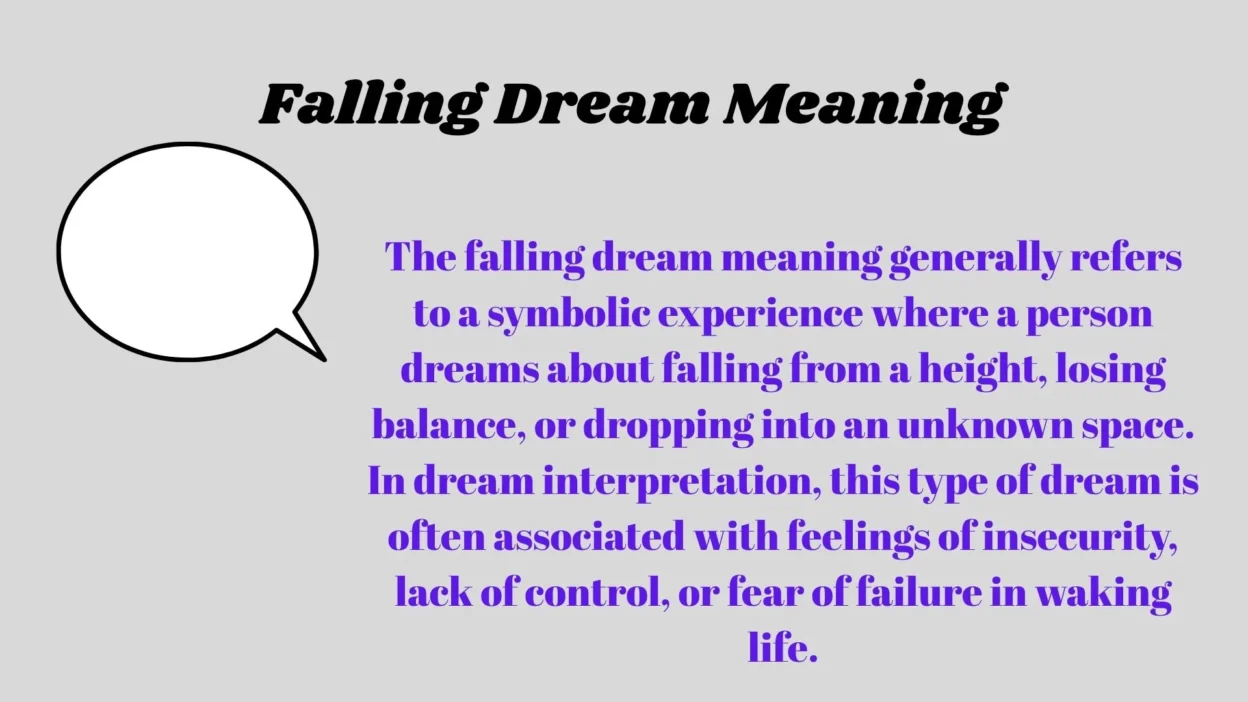
The falling dream meaning generally refers to a symbolic experience where a person dreams about falling from a height, losing balance, or dropping into an unknown space. In dream interpretation, this type of dream is often associated with feelings of insecurity, lack of control, or fear of failure in waking life.
Psychologically, falling in a dream can represent a sense of instability. For example, if someone is going through major life changes—such as losing a job, ending a relationship, or facing uncertainty—they may experience falling dreams as a reflection of their emotional state.
Another common interpretation is related to letting go. Falling may symbolize surrendering control or being forced into a situation where outcomes are uncertain. While this can feel frightening, it doesn’t always carry a negative meaning. In some cases, it can represent transformation or personal growth.
It’s also worth noting that falling dreams can be influenced by physical sensations. Sometimes, your body may twitch or relax suddenly during sleep (a phenomenon called a hypnic jerk), which your brain interprets as falling.
Overall, the meaning depends heavily on the dreamer’s emotions during the dream. Feeling scared suggests anxiety, while feeling calm might indicate acceptance of change.
Background with Examples
The interpretation of falling dreams dates back to ancient civilizations. Early cultures often believed that dreams were messages from higher powers or reflections of the soul’s journey. Falling, in particular, was sometimes seen as a warning sign or a symbol of losing favor with spiritual forces.
In modern psychology, thinkers like Sigmund Freud and Carl Jung offered different perspectives. Freud believed falling dreams were linked to anxiety and loss of control, often connected to personal fears or suppressed emotions. Jung, on the other hand, saw them as part of the subconscious trying to restore balance or signal a need for grounding.
For example, imagine a student preparing for important exams. The stress and fear of failure might manifest as a dream where they fall endlessly. Similarly, someone entering a new relationship might dream of falling if they feel emotionally vulnerable or uncertain.
Another example could be a professional facing career instability. A sudden job change or financial pressure may trigger repeated falling dreams, reflecting insecurity about the future.
Interestingly, not all falling dreams are negative. Some people report feeling free or weightless while falling, which can symbolize letting go of burdens or embracing change.
These examples show that falling dreams are deeply personal and often mirror real-life emotions, making them one of the most relatable dream experiences.
Usage in Different Contexts (Chat, Social Media, Professional Fields)
While the falling dream meaning is primarily used in dream interpretation, the phrase and concept also appear in everyday conversations and digital spaces. People often use it metaphorically to describe emotional or life situations.
In casual chat, someone might say, “I feel like I’m falling,” to express losing control or feeling overwhelmed. On social media, users share their dreams and ask for interpretations, often using hashtags like #DreamMeaning or #FallingDream. These discussions create a shared space where people relate their personal experiences to broader interpretations.
In professional fields, especially psychology and therapy, falling dreams are discussed as indicators of stress, anxiety, or transitional phases. Therapists may use such dreams to help clients explore underlying emotions and identify triggers in their daily lives.
Even in creative industries, such as writing and filmmaking, falling is used as a symbolic element. It often represents conflict, transformation, or a turning point in a character’s journey.
Overall, the concept extends beyond dreams and becomes a metaphor for emotional states, making it widely relevant across various contexts.
Meaning in Chat, WhatsApp, Instagram, TikTok
On platforms like WhatsApp, Instagram, and TikTok, the falling dream meaning has become part of digital storytelling and self-expression. Users frequently share short clips or posts describing their dreams, asking followers for interpretations.
For example, a TikTok video might say, “If you dream about falling, it means you’re losing control in real life.” While such interpretations are simplified, they often resonate with viewers and spark engagement.
On Instagram, people may post captions like, “Had a falling dream again—what does it mean?” This invites interaction and creates a sense of community. Similarly, in WhatsApp chats, friends might casually discuss their dreams and relate them to stress or life events.
However, it’s important to recognize that social media interpretations are often generalized. While they can be relatable, they may not fully capture the complexity of individual experiences.
Still, these platforms play a significant role in spreading awareness about dream meanings and encouraging people to reflect on their subconscious thoughts.
Meaning in Physics, Medical, and Aircraft Terminology
Outside of dream interpretation, “falling” has specific meanings in scientific and technical fields, which differ from the falling dream meaning.
In physics, falling refers to motion caused by gravity. Objects fall toward the Earth due to gravitational force, and this concept is fundamental to understanding mechanics and motion.
In medical terms, falling can relate to physical incidents, especially in elderly care, where falls are a major health concern. Additionally, the sensation of falling during sleep is linked to hypnic jerks, a natural muscle spasm that occurs as the body transitions into sleep.
In aviation, falling is not typically used in a technical sense. Instead, terms like “descent,” “stall,” or “loss of altitude” are used to describe downward movement of an aircraft.
These distinctions highlight how the same word can carry very different meanings depending on the context.
Common Misconceptions
One common misconception about the falling dream meaning is that it always predicts something bad. Many people believe it’s a sign of failure or impending danger, but this isn’t necessarily true.
Another myth is that everyone shares the same interpretation. In reality, dream meanings are highly personal and influenced by individual experiences, emotions, and circumstances.
Some also think falling dreams are purely psychological, ignoring the physical aspect. As mentioned earlier, body movements during sleep can trigger these dreams.
Understanding these misconceptions helps create a more balanced and accurate view of falling dreams.
Similar Terms & Alternatives
Several related dream themes are often confused with falling dreams. These include flying dreams, slipping dreams, and drowning dreams.
Flying dreams typically symbolize freedom and control, which is almost the opposite of falling. Slipping dreams may indicate minor insecurities or fear of making mistakes. Drowning dreams often relate to feeling overwhelmed by emotions.
Recognizing these differences helps in interpreting dreams more accurately.
How to Respond to It
If you frequently experience falling dreams, the best response is to reflect on your current life situation. Ask yourself if you’re feeling stressed, uncertain, or out of control in any area.
Keeping a dream journal can also help identify patterns. Writing down your emotions and events before sleep may reveal connections between your waking life and dreams.
Practicing relaxation techniques, such as meditation or deep breathing, can reduce stress and improve sleep quality.
If the dreams are intense or recurring, speaking with a therapist may provide deeper insights.
Differences from Similar Words
The falling dream meaning differs from related concepts mainly in symbolism and emotional impact. For example, “flying” suggests empowerment, while “falling” indicates loss of control.
Similarly, “dropping” may refer to a sudden event, whereas falling often involves a prolonged sense of descent and uncertainty.
Understanding these nuances helps clarify dream interpretations and avoids confusion.
Relevance in Online Conversations & Dating Apps
Interestingly, the falling dream meaning has also found its way into online conversations and dating apps. People often use dream discussions as icebreakers or conversation starters.
For example, asking “What does it mean if you dream about falling?” can spark meaningful discussions and reveal personal insights. It allows individuals to share experiences and connect on a deeper level.
In online communities, discussing dreams creates engagement and fosters curiosity. It’s a simple yet effective way to build connections and explore shared human experiences.
Conclusion
The falling dream meaning is a fascinating blend of psychology, emotion, and personal experience. While it often reflects feelings of insecurity or loss of control, it can also symbolize transformation and growth.
Understanding this dream requires looking beyond generic interpretations and considering your own emotions and life circumstances. Whether influenced by stress, physical sensations, or subconscious thoughts, falling dreams offer valuable insights into your inner world.
By exploring their meaning and context, you can better understand yourself and navigate life’s challenges with greater awareness.

I’m Silas Everhart, a storyteller who loves weaving tales that linger in the mind.
Through lushystories.com, I share my journeys into passion, mystery, and imagination.
Every story I write is a piece of my soul, hoping to connect with readers worldwide.