If you’ve spent any time on TikTok, Instagram, or messaging apps, you’ve probably seen someone reply with just one word: “cap.” It’s short, simple, and somehow powerful—but what does it actually mean? The phrase has quickly become a staple in online communication, especially among younger audiences.
People search for the cap slang meaning because it often appears in viral videos, memes, and everyday chats, leaving many confused about whether it’s positive, negative, or just playful.
Understanding modern slang like this helps you stay connected in digital conversations and avoid awkward misunderstandings. The word “cap” has evolved beyond its traditional meaning and now carries a completely different tone in casual communication.
In this article, we’ll break down what it means, where it came from, how it’s used across platforms, and even how it compares to similar slang terms.
Meaning & Definition
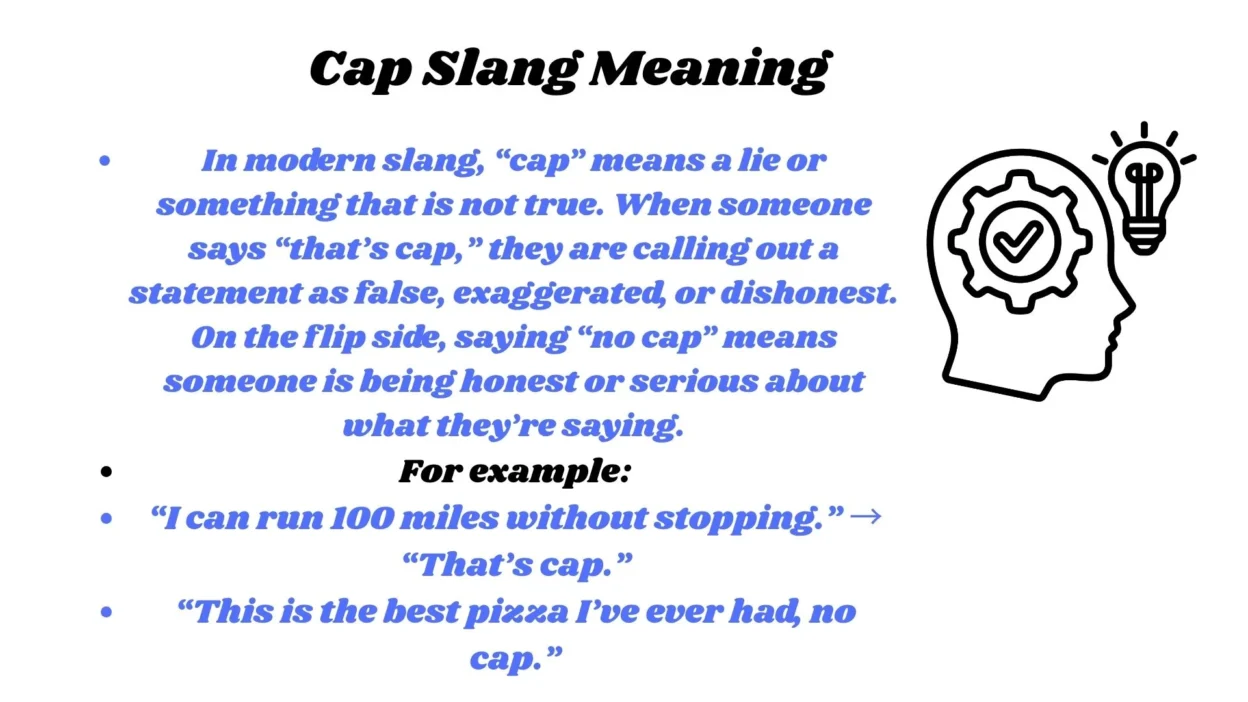
In modern slang, “cap” means a lie or something that is not true. When someone says “that’s cap,” they are calling out a statement as false, exaggerated, or dishonest. On the flip side, saying “no cap” means someone is being honest or serious about what they’re saying.
For example:
- “I can run 100 miles without stopping.” → “That’s cap.”
- “This is the best pizza I’ve ever had, no cap.”
The term is often used casually and doesn’t always imply malicious lying—it can also refer to exaggeration or playful bragging. Tone and context matter a lot here. Among friends, calling something “cap” can be lighthearted, but in other situations, it might come across as confrontational.
What makes this slang so popular is its simplicity. Instead of writing a full sentence like “I don’t believe you,” people can just say “cap.” It’s efficient, expressive, and widely understood across social media platforms.
Background with Examples
The origin of the cap slang meaning can be traced back to African American Vernacular English (AAVE). The word “cap” has been used for decades to refer to lying or boasting. Over time, it gained mainstream popularity through hip-hop culture and music lyrics, where artists used it to call out fake behavior or dishonesty.
The phrase exploded in popularity around 2017–2020, thanks to platforms like Twitter, TikTok, and Instagram. Influencers and creators began using “cap” and “no cap” in videos, captions, and comments, making it part of everyday online language.
Examples from pop culture:
- In rap songs, artists often say “no cap” to emphasize authenticity.
- TikTok users might post something unbelievable and caption it “no cap,” even if it’s clearly exaggerated for humor.
- Meme culture frequently uses “cap” to mock unrealistic claims.
For instance, someone might post a photo of a luxury lifestyle and claim they achieved it overnight. Comments will quickly fill with “cap” as users express skepticism.
The spread of this slang highlights how digital culture shapes language. What started in a specific community has now become global, used by millions across different countries and age groups.
Usage in Different Contexts (Chat, Social Media, Professional Fields)
In casual chats, “cap” is used to quickly challenge or question someone’s statement. It’s common in text messages, gaming chats, and group conversations where speed and brevity matter.
On social media, the term takes on a broader role. It can be used in captions, comments, or even as part of trends. For example, influencers might ask followers to comment “cap or no cap” to vote on whether something is true.
In professional settings, however, using “cap” is generally not appropriate. It’s considered informal slang and may come across as unprofessional or confusing to colleagues unfamiliar with internet culture. Instead, phrases like “that seems inaccurate” or “I disagree” are more suitable.
That said, in creative industries or marketing teams targeting younger audiences, slang like “cap” might occasionally appear in campaigns to sound relatable. Brands on platforms like TikTok often adopt such language to connect with Gen Z users.
Overall, context is key. What works in a casual chat may not work in a workplace email.
Meaning in Chat, WhatsApp, Instagram, TikTok
The cap slang meaning stays consistent across platforms, but the way it’s used can vary slightly.
- Chat & WhatsApp: Often used in quick replies like “cap” or “no cap” during conversations.
- Instagram: Common in captions and comments, especially under posts that seem exaggerated.
- TikTok: Frequently used in videos, hashtags (#nocap), and trends where users challenge each other’s claims.
For example:
- TikTok: “I woke up at 5 AM every day this year. No cap.”
- Instagram comment: “You met that celebrity? Cap.”
- WhatsApp: “Bro says he finished the project in one hour. Cap.”
The informal nature of these platforms makes slang feel natural and engaging. It also helps users express reactions quickly without typing long responses.
Meaning in Physics, Medical, and Aircraft Terminology
Outside slang, “cap” has completely different meanings depending on the field.
- Physics: “Cap” is often short for capacitance or capacitor, which refers to a device that stores electrical energy.
- Medical: It can refer to a cap, such as a protective covering (e.g., a dental cap or surgical cap).
- Aircraft: “Cap” might be used informally to refer to components like protective caps or covers in aviation systems.
These meanings are entirely unrelated to the slang version. The confusion usually arises when people encounter the term in different contexts and assume the same definition applies.
Understanding the difference helps avoid misinterpretation, especially in technical or academic discussions.
Common Misconceptions
One common misconception is that “cap” always means someone is lying intentionally. In reality, it can also refer to exaggeration, joking, or playful teasing.
Another misunderstanding is that “no cap” means “no problem” or “no limit.” While it may sound similar, it specifically means “I’m not lying” or “I’m being honest.”
Some people also assume it’s a new term, but it has deeper cultural roots and has simply gained wider exposure through social media.
Similar Terms & Alternatives
Several slang terms have similar meanings to “cap,” including:
- “Fake” – Something not real
- “Lie” – Direct dishonesty
- “BS” – Informal way to call something false
- “For real” / “FR” – Similar to “no cap”
Each term carries slightly different tones. For example, “cap” is more casual and trendy, while “lie” is more direct and serious.
How to Respond to It
If someone calls your statement “cap,” you can respond in a few ways depending on the tone:
- Clarify: “No cap, I’m serious.”
- Provide proof: “I’ll show you screenshots.”
- Joke back: “Okay, maybe a little cap.”
The response depends on whether the conversation is serious or playful.
Differences from Similar Words
Unlike words like “lie” or “false,” “cap” often carries a lighter, more conversational tone. It’s less formal and more tied to internet culture. Saying “that’s a lie” can feel confrontational, while “that’s cap” might feel more casual among peers.
Relevance in Online Conversations & Dating Apps
In online conversations and dating apps, understanding slang like “cap” helps you communicate more naturally. It can also help you interpret others’ messages correctly.
For example, if someone says “I’m the best cook ever, no cap,” they’re emphasizing confidence. If another user replies “cap,” they might be teasing or expressing doubt.
Using slang appropriately can make interactions feel more relatable, but overusing it may come across as forced.
Conclusion
The cap slang meaning has become an essential part of modern digital communication. It’s a quick, expressive way to call out exaggeration or confirm honesty, depending on how it’s used.
While it originated in AAVE and gained popularity through music and social media, it has now become a global term understood by millions.
Like most slang, its effectiveness depends on context. It works best in casual conversations, social media interactions, and informal chats, but should be avoided in professional settings.
Understanding its meaning, variations, and proper usage helps you stay current with online trends and communicate more effectively.
As language continues to evolve, terms like “cap” show how creativity and culture shape the way we express ourselves. If you’re scrolling through TikTok or chatting with friends, knowing what it means ensures you’re always in the loop.

I am Luna Marlowe, a creative soul drawn to stories, art, and the quiet emotional spaces people rarely name.
My life has been shaped by observation and imagination, turning everyday moments into meaning through words and reflection.
I share my work and stories on lushystories.com, believing self-expression is both a refuge and a way to connect deeply with others.