If you’ve ever been in an online chat or scrolling through social media and suddenly saw someone type “ASL?”, you might have paused and wondered what it means. Is it a typo? A code? Or something more specific? The ASL slang meaning has been around for decades, yet it continues to confuse new internet users and even younger generations encountering it for the first time.
People search for this term because its meaning can shift depending on context. In one conversation, it may be a simple question about identity, while in another, it could relate to technical fields like science or aviation. This dual usage makes it both popular and occasionally misunderstood.
In this article, we’ll break down the meaning, origin, and different uses of ASL across chats, social platforms, and professional environments—so you can confidently understand and respond the next time you see it.
Meaning & Definition
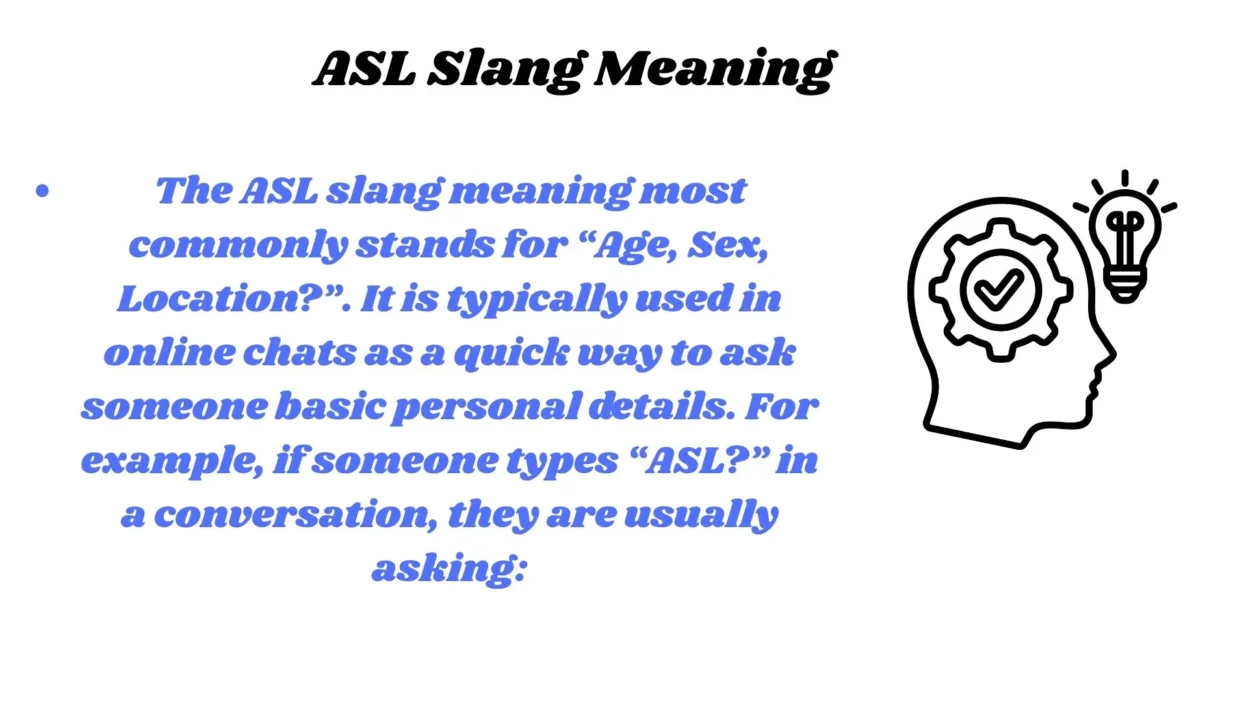
The ASL slang meaning most commonly stands for “Age, Sex, Location?”. It is typically used in online chats as a quick way to ask someone basic personal details. For example, if someone types “ASL?” in a conversation, they are usually asking:
- How old are you?
- What is your gender?
- Where are you from?
This shorthand became popular because early internet chatrooms required fast typing and minimal text. Instead of writing three separate questions, users condensed them into a simple acronym.
However, ASL is also an abbreviation with completely different meanings outside of casual chat. For instance:
- American Sign Language – a widely used visual language in the Deaf community
- Above Sea Level – used in geography and aviation
- Asl (age/sex/location) – the informal chat version
Because of these multiple definitions, context plays a huge role. If someone uses ASL in a scientific paper, they are not asking for your age or gender. But in a chatroom or dating app, that’s almost certainly what they mean.
Understanding which meaning applies depends on where and how the term is used.
Background and Origin (with Examples)
The ASL slang meaning dates back to the early days of the internet in the late 1990s and early 2000s. It became widely popular on platforms like AOL Instant Messenger (AIM), IRC chatrooms, and early forums. Back then, users often interacted with strangers, and ASL was the quickest way to establish basic identity.
For example:
- User1: “Hey”
- User2: “Hi, ASL?”
- User1: “18/F/UK”
This format allowed users to quickly decide whether they wanted to continue the conversation, especially in casual or dating-related chats.
Over time, ASL became part of internet culture. However, as social media platforms evolved and profiles began displaying personal information automatically, the use of ASL declined. Still, it hasn’t disappeared entirely—it now appears more in nostalgic, meme-based, or niche online communities.
Interestingly, the acronym also gained separate recognition through American Sign Language, which has nothing to do with chat slang. This overlap has led to confusion, especially among younger users who might associate ASL primarily with sign language rather than internet shorthand.
Usage in Different Contexts
The meaning of ASL can vary widely depending on where it’s used. In casual conversation, it often retains its original slang meaning. But in more formal or professional settings, it shifts entirely.
In chat environments, ASL is used to quickly gather basic personal details. It’s informal and often used among strangers.
On social media platforms, the term may appear ironically or humorously. People sometimes use it in memes or to reference “old internet culture.”
In professional fields, ASL takes on entirely different meanings. For example:
- In linguistics: American Sign Language
- In aviation: Above Sea Level
- In scientific contexts: Altitude measurements
Because of this variation, it’s important not to assume the meaning without context. A casual DM and a technical document require completely different interpretations.
Meaning in Chat, WhatsApp, Instagram, TikTok
On platforms like WhatsApp, Instagram, and TikTok, the ASL slang meaning still primarily refers to “Age, Sex, Location,” but its usage has evolved.
- WhatsApp: Rarely used unless chatting with strangers or in group chats
- Instagram: Sometimes appears in DMs or comments, often playfully or sarcastically
- TikTok: More likely to be used in memes or nostalgic content about early internet culture
For example, a TikTok comment might say:
“Not him asking ASL in 2025 😭”
This shows how the phrase is now sometimes used humorously rather than seriously.
Meaning in Physics, Medical, and Aircraft Terminology
Outside of slang, ASL has several important technical meanings:
- Physics/Geography: ASL means Above Sea Level, used to measure altitude
- Medical Field: Often refers to Age, Sex, Location in patient data shorthand, though less commonly abbreviated this way
- Aviation: A critical term indicating altitude relative to sea level, essential for navigation and safety
These meanings are precise and context-driven, unlike the casual nature of internet slang. Misunderstanding ASL in these contexts could lead to confusion or even serious errors, especially in aviation or scientific discussions.
Common Misconceptions
One of the biggest misconceptions about the ASL slang meaning is that it always refers to American Sign Language. While that is a valid and widely recognized meaning, it’s not the same as the chat acronym.
Another misconception is that ASL is still widely used in modern conversations. In reality, it’s less common today and often seen as outdated or even intrusive, especially when used with strangers.
Some also assume it’s harmless in all contexts, but asking “ASL?” can sometimes feel too direct or personal, particularly in online spaces where privacy is valued.
Similar Terms & Alternatives
Instead of using ASL, people today prefer more natural or respectful ways to ask about someone:
- “Where are you from?”
- “How old are you?” (when appropriate)
- “Tell me about yourself”
Other slang alternatives may include abbreviations like:
- A/S/L (same meaning, different format)
- Profile-based introductions (no acronym needed)
Modern communication tends to favor more conversational and less abrupt approaches.
How to Respond to It
If someone asks you “ASL?”, your response depends on your comfort level.
You can:
- Answer directly: “25/M/Canada”
- Be partial: “Mid-20s, Europe”
- Decline politely: “I’d rather not share that right now”
It’s completely okay to set boundaries, especially when interacting with strangers online.
Differences from Similar Words
ASL differs from other abbreviations because it combines three questions into one. Unlike single-meaning acronyms, it requires interpretation based on context.
For example:
- DM = Direct Message
- BRB = Be Right Back
- ASL = Multi-meaning (chat slang, sign language, altitude term)
This makes it more flexible—but also more confusing.
Relevance in Online Conversations & Dating Apps
In modern online conversations, the ASL slang meaning is less dominant but still relevant. On dating apps, asking directly for personal details is usually replaced with profile browsing.
However, ASL may still appear:
- In anonymous chat platforms
- In retro internet communities
- As a joke or meme
Its relevance today lies more in cultural recognition than everyday use.
Conclusion
The ASL slang meaning has evolved from a widely used internet shortcut to a term that now carries both nostalgic and contextual significance. While it originally stood for “Age, Sex, Location” in chatrooms, its meaning today depends heavily on where and how it’s used.
Understanding ASL requires awareness of context—whether you’re reading a casual message, browsing social media, or interpreting technical information. Although it’s no longer as common in modern communication, it still appears in niche spaces and online humor.
By knowing its meanings and variations, you can avoid confusion and respond appropriately.
If you encounter it in a DM or a professional document, you’ll now understand exactly what ASL stands for and how to handle it.

I’m Jasper Wren, a storyteller fascinated by the shadows between desire and curiosity. I craft tales that linger long after the last word. Explore my world and latest stories at LushyStories.