The phrase “another one bites the dust” is widely recognized across cultures, thanks largely to music, pop culture, and everyday conversations. But what does it actually mean, and why do people use it so often? Many search for the another one bites the dust meaning when they hear it in songs, memes, or casual chat and want to understand its deeper implication.
At its core, this expression reflects a sense of finality—often used when someone fails, something ends, or a person is defeated. Whether it’s said jokingly among friends or used seriously in storytelling, the phrase carries a tone that can range from humorous to dramatic.
In today’s digital age, it has evolved beyond its original usage and appears frequently on social media platforms like TikTok, Instagram, and WhatsApp.
This article breaks down its meaning, origin, and usage across different contexts so you can understand and use it confidently.
Meaning & Definition
The phrase “another one bites the dust” generally means that someone or something has failed, been defeated, or come to an end. It often implies that the outcome was expected or inevitable. The “dust” symbolizes defeat or downfall, while “biting the dust” suggests hitting the ground or losing completely.
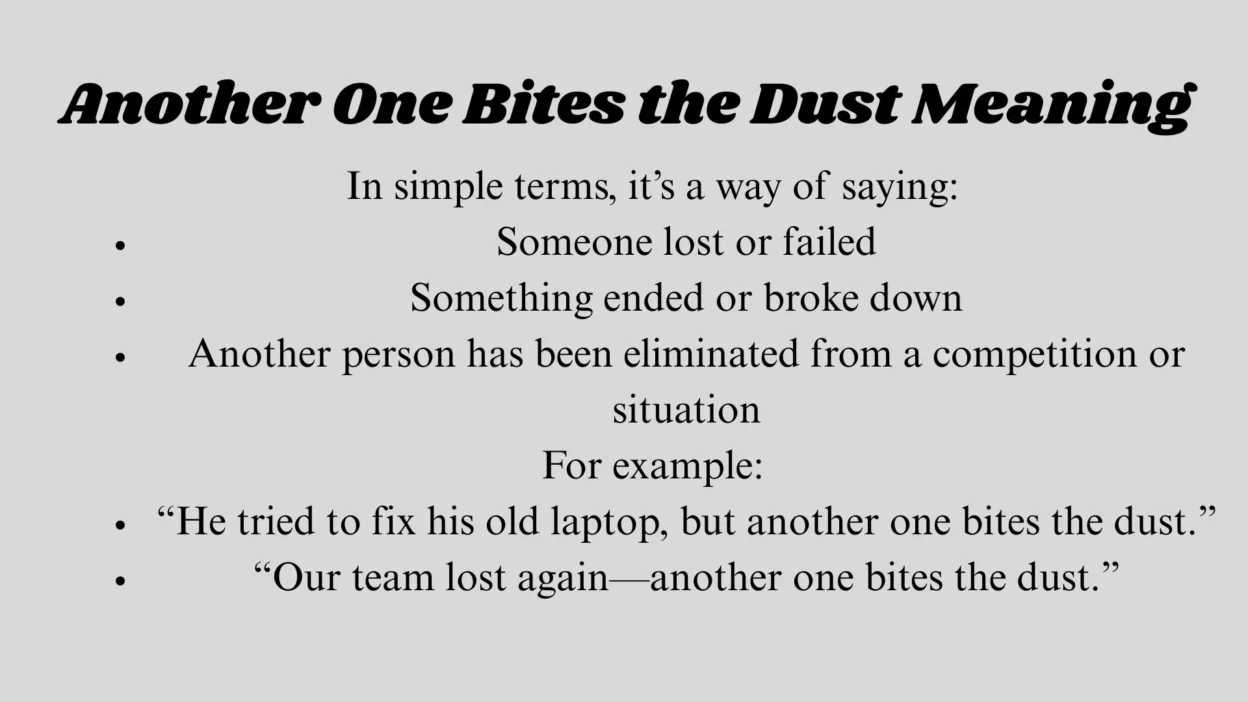
In simple terms, it’s a way of saying:
- Someone lost or failed
- Something ended or broke down
- Another person has been eliminated from a competition or situation
For example:
- “He tried to fix his old laptop, but another one bites the dust.”
- “Our team lost again—another one bites the dust.”
The tone of this phrase can vary depending on context. Sometimes it’s playful and humorous, especially when used among friends. Other times, it may sound harsh or insensitive if used in serious situations, such as discussing real-life failures or losses.
Interestingly, the phrase doesn’t always carry a negative emotional weight. In competitive environments, it may simply mark progress—like one opponent being eliminated. In casual conversation, it can even be used sarcastically or dramatically to exaggerate minor inconveniences.
Overall, the another one bites the dust meaning revolves around endings, defeat, or removal, making it a versatile and expressive phrase in English.
Background with Examples
The phrase gained massive popularity from Queen’s iconic 1980 song “Another One Bites the Dust.” Written by bassist John Deacon, the song uses the expression metaphorically to describe people falling one by one, particularly in a tough or dangerous environment.
However, the expression existed long before the song. Historically, “bite the dust” dates back to ancient times, even appearing in literature like Homer’s Iliad, where fallen warriors were described as hitting the ground in defeat. Over time, the phrase evolved into modern English as a way to describe loss or failure.
Examples in different scenarios:
- Sports: “That’s the third player out—another one bites the dust.”
- Gaming: “You got eliminated again? Another one bites the dust!”
- Everyday life: “My phone just stopped working… another one bites the dust.”
The song helped cement the phrase in pop culture, making it instantly recognizable worldwide. Today, it’s often used humorously or dramatically, especially in memes and viral content.
Because of its catchy rhythm and cultural impact, the phrase is often quoted in a lighthearted way—even when describing small or trivial failures.
Usage in Different Contexts (Chat, Social Media, Professional Fields)
In modern communication, “another one bites the dust” has become highly adaptable. Its meaning shifts slightly depending on where and how it’s used.
In casual chat, it’s often used humorously:
- “My diet lasted two days… another one bites the dust.”
On social media, the phrase appears in captions, memes, and short videos:
- TikTok clips showing failed attempts often include the phrase for comedic effect.
- Instagram captions might use it to dramatize minor setbacks.
In professional settings, the phrase is less common but still used informally:
- “The project didn’t meet expectations—another one bites the dust.”
However, in formal environments, it can sound unprofessional or insensitive, especially when referring to people or serious failures.
The phrase is most effective when used in light, informal situations where humor or exaggeration is appropriate. Its adaptability is one of the reasons it remains popular across different platforms and age groups.
Meaning in Chat, WhatsApp, Instagram, TikTok
In digital conversations, the another one bites the dust meaning often becomes more playful and exaggerated.
- WhatsApp: Used among friends to react to small failures
- “Your crush ignored your message? Another one bites the dust 😂”
- Instagram: Common in captions or reels
- “Tried baking again… another one bites the dust.”
- TikTok: Frequently paired with dramatic or funny videos
- Fails, transformations, or eliminations often use the phrase as a punchline
- Chat slang: It may be shortened or implied through memes or GIFs
In these contexts, the phrase rarely carries serious negativity. Instead, it adds humor, relatability, and a touch of drama. It’s part of internet culture where exaggeration makes content more engaging.
Meaning in Physics, Medical, and Aircraft Terminology
While primarily idiomatic, “another one bites the dust” is not a technical term in physics, medicine, or aviation. However, it may appear informally in these fields.
- Physics: Scientists might jokingly use it when an experiment fails
- “The circuit burned out—another one bites the dust.”
- Medical field: Rare and informal, sometimes used humorously among colleagues (though often avoided due to sensitivity)
- Aircraft/Engineering: May describe equipment failure in a casual tone
- “Engine component failed—another one bites the dust.”
In all these cases, the phrase is metaphorical, not scientific terminology. Professionals typically avoid it in official communication because it can sound unprofessional or insensitive.
Common Misconceptions
One common misconception is that the phrase always refers to death. While it can be used in that context, it more often refers to failure or defeat.
Another misunderstanding is that it’s always negative. In reality, it can be humorous or even celebratory, especially in competitive situations.
Some people also assume it’s a modern slang term, but its roots go back centuries. The Queen song simply made it globally famous.
Understanding these nuances helps avoid misusing the phrase in serious or inappropriate situations.
Similar Terms & Alternatives
Several expressions carry a similar meaning:
- “Bite the dust”
- “Game over”
- “That’s the end of the road”
- “Another one down”
- “Out for the count”
Each has a slightly different tone. For example, “game over” is more modern and casual, while “out for the count” is often used in sports or boxing contexts.
How to Respond to It
Your response depends on the tone and situation:
- Humorous: “Haha, better luck next time!”
- Supportive: “Don’t worry, you’ll get it next time.”
- Neutral: “Yeah, that didn’t work out.”
Avoid using humor if the situation is serious, as it may come across as insensitive.
Differences from Similar Words
Unlike simple terms like “failed” or “lost,” “another one bites the dust” adds emotion and storytelling. It emphasizes repetition—suggesting this is not the first failure.
Compared to “game over,” it feels more dramatic and expressive. Compared to “another one down,” it has a stronger cultural and musical association.
Relevance in Online Conversations & Dating Apps
On dating apps and online chats, the phrase is often used humorously:
- “Got ghosted again… another one bites the dust.”
It helps people cope with rejection in a lighthearted way. However, overuse can make it seem sarcastic or dismissive, so context matters.
In online conversations, it remains popular because it’s expressive, relatable, and instantly recognizable.
Conclusion
Understanding the another one bites the dust meaning helps you use this iconic phrase more effectively in everyday conversations. Ifdescribing a small failure, a lost opportunity, or a humorous setback, the expression adds personality and drama to communication.
Its origins in history and music give it cultural depth, while its adaptability keeps it relevant in modern digital spaces. From WhatsApp chats to TikTok videos, the phrase continues to thrive as a relatable and expressive way to describe endings and defeats.
Just remember to use it thoughtfully—while it’s perfect for lighthearted situations, it may not suit more serious contexts. When used correctly, it can make your communication more engaging, memorable, and fun.

I am Luna Marlowe, a creative soul drawn to stories, art, and the quiet emotional spaces people rarely name.
My life has been shaped by observation and imagination, turning everyday moments into meaning through words and reflection.
I share my work and stories on lushystories.com, believing self-expression is both a refuge and a way to connect deeply with others.